
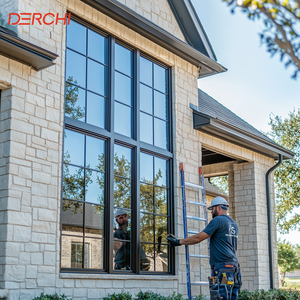
DERCHI USA Popular Crank Casement Window Thermal Break Double Glass Crank Out Casement Windows with Decoration Grills
Thermal Break Double Glazed Tinted Crank Out
Engineered with double-glazed tinted glass, fusion-welded virgin PVC, and high-tensile thermal break aluminum to withstand Uruguay's intense coastal UV radiation and humid estuarine air.
The Oriental Republic of Uruguay, situated strategically along the Rio de la Plata and the South Atlantic Ocean, represents a highly specialized market for architectural fenestration and tinted glass technologies. Driven by rapid urbanization in Montevideo, luxury real estate development across Punta del Este and La Barra, and stringent thermal efficiency mandates across Mercosur regional trade networks, Uruguayan property developers, civil contractors, and architectural specifiers increasingly demand high-performance tinted glass solutions.
Uruguay experiences a humid subtropical climate (Cfa under the Köppen climate classification) characterized by high UV index levels during summer months, strong coastal winds (Sudestada and Pampero), and notable atmospheric salinity along its 660-kilometer coastline. Standard monolithic clear float glass fails to provide adequate thermal comfort, resulting in high internal cooling loads, excessive solar glare, and premature interior fading. As a primary manufacturer and global exporter of high-grade fenestration, our direct-to-site export models bridge the gap between advanced manufacturing engineering and local Uruguayan building requirements.
To engineer fenestration systems tailored to local performance criteria, our manufacturing lines integrate solar control tinted glass packages with fusion-welded virgin vinyl (uPVC) and thermal-break aluminum profiles. This dual approach addresses three fundamental environmental challenges in Uruguay:
Summer solar radiation along the Southern Cone generates significant heat gain. Body-tinted glass (grey, bronze, green, and cobalt blue) combined with spectrally selective Low-E coatings cuts infrared transmittance while absorbing up to 99% of damaging ultraviolet light.
Salt-laden maritime air along Montevideo’s Rambla and Maldonado’s coastline severely degrades inferior metal frames. Our 100% virgin uPVC profiles and anodized/powder-coated thermal break aluminum frames offer zero-corrosion longevity without pitting or flaking.
Uruguay's winter months bring cold southern winds requiring low U-factors to retain indoor heating. Dual-sealed insulating glass units (IGUs) filled with 90%+ Argon gas prevent conductive heat loss, maintaining optimal microclimates year-round.
Tailored structural, thermal, and aesthetic fenestration solutions matching the specific architectural typologies of Uruguay's key departments.
Primary Siting: Pocitos, Punta Carretas, Puerto Buceo, and Downtown Financial District.
Primary Siting: Playa Mansa, Playa Brava, La Barra, Jose Ignacio, and Manantiales.
Primary Siting: Barrio Histórico, Real de San Carlos, and suburban residential estates.
Primary Siting: Zonamerica, Parque de las Ciencias, Salto, Paysandú, and Rivera.
Empirical performance data for engineering teams, architects, and compliance officers evaluating fenestration schedules in Uruguay.
| Glazing Configuration | Visible Light Transmittance (VLT) | Solar Heat Gain Coefficient (SHGC) | U-Factor (W/m²·K) | Acoustic Rating (STC) | Recommended Uruguay Application |
|---|---|---|---|---|---|
| Euro Grey Tinted Dual Pane (6+12Ar+6) | 42% | 0.31 | 1.45 W/m²·K | 36 dB | Commercial Towers & Multi-Family Residential |
| Bronze Tinted + LoĒ³-366 (6+12Ar+6) | 38% | 0.22 | 1.18 W/m²·K | 38 dB | Punta del Este Oceanfront Villas & South Facing Facades |
| French Green Solar Control (5+10Ar+5) | 65% | 0.40 | 1.55 W/m²·K | 34 dB | Institutional, Schools & Interior Office Parks |
| Laminated Acoustic Grey Tint (4+0.76PVB+4+12Ar+6) | 35% | 0.28 | 1.30 W/m²·K | 42 dB | Hospitality & High-Noise Arterial Corridors (Montevideo) |
| Clear Low-E Standard (Standard Baseline) | 72% | 0.58 | 1.80 W/m²·K | 30 dB | Inland Agricultural Facilities & Shaded Low-Rise Build |
Tinted float glass is manufactured by introducing inorganic metal oxides (such as iron, cobalt, and selenium) during the molten glass stage. This fundamentally alters the solar radiation absorption spectrum of the pane. While standard clear glass transmits upwards of 83% of total solar energy, body-tinted glass selectively absorbs specific wavelengths:
Critical Engineering Note on Thermal Stress: Tinted glass absorbs solar energy and consequently operates at higher temperatures than clear float glass. Under direct sun exposure in Uruguay’s summer, localized thermal expansion can induce tensile stress along the pane edges. To prevent thermal breakage, our export factory fully tempers (heat-strengthens) all tinted glass units intended for South American markets, elevating mechanical flexural strength to ≥ 120 MPa in compliance with international safety codes (ISO 12543 / EN 12150).
Eliminating intermediary markups, controlling extrusion quality, and delivering precision fenestration directly to Puerto de Montevideo.
Unlike assemblers who purchase frame kits, we extrude our own virgin PVC profiles and thermal-break aluminum frames under strict metallurgical control. Corners are fusion-welded into monolithic structural units—eliminating screwed joints, corner gaskets, and water leakage paths.
Our vinyl profiles utilize exclusively 100% virgin uPVC compound fortified with titanium dioxide (TiO2) UV stabilizers. We never blend reground scrap vinyl into our export lines, preventing yellowing, chalking, embrittlement, or structural distortion under South American sun exposure.
Every single fenestration unit is built to order in precise 1/8-inch (3.175mm) increments. Custom arch windows, trapezoids, stacked picture combinations, and non-standard rough openings are produced seamlessly on the same automated machinery platform.
Exporting to South America demands rugged packing. All window and door units are individually edge-protected with corner foam, shrink-wrapped, and secured in fumigated hardwood A-frame crates designed for sea-freight container transit to Montevideo.
We supply full submittal packages including certified NFRC thermal test data, structural wind-load calculations, detailed CAD shop drawings, and bill-of-materials certifications required for Uruguayan municipal permit approvals.
Our limited lifetime warranty covers profile structural integrity, fusion-welded corner joints, hardware operational failure, and insulating glass hermetic seal failure against internal fogging or stress cracking.
The building sector in Uruguay is undergoing a structural transition toward energy sustainability, spearheaded by the Ministry of Industry, Energy and Mining (MIEM) and national energy efficiency directives. Building projects across Montevideo and interior regions are increasingly evaluated against local standards formulated by UNIT (Instituto Uruguayo de Normas Técnicas) as well as international green building rating systems such as LEED and EDGE.
Similar to European energy performance certificates, Uruguay has introduced thermal envelope performance criteria. Fenestration systems are evaluated based on total assembly U-factor and SHGC values. Windows fitted with double-glazed tinted glass and thermal break profiles meet the stringent Tier-A insulation benchmarks, reducing HVAC electrical demand from UTE (Administración Nacional de Usinas y Trasmisiones Eléctricas).
Contemporary architectural trends in Punta del Este emphasize seamless indoor-outdoor living, requiring expansive glass spans. Micro-slim thermal break frames housing thick, heat-strengthened grey or bronze tinted IGUs allow architects to design 3-meter-tall sliding glass elevations without sacrificing lateral structural integrity or thermal comfort.
As Uruguay solidifies its status as a financial and logistics hub in South America, international commercial developers demand supply chains that deliver verified performance credentials. Direct factory procurement ensures full compliance with international standards while maintaining cost-competitive freight consolidation to Montevideo.
Essential answers regarding customs clearance, sea freight logistics, technical customization, and product compliance for Uruguay.
We export factory-direct via Full Container Load (FCL 20ft/40ft HQ) or Less than Container Load (LCL) consolidated freight directly to Puerto de Montevideo. All shipments include complete commercial invoices, packing lists with itemized window call sizes, bill of lading (B/L), and phytosanitary certificates for timber crates to ensure smooth clearance through Uruguayan Customs (Aduana Uruguaya).
Yes. We offer a comprehensive spectrum of float glass tints including Euro Grey, Dark Grey, Architectural Bronze, French Green, and Blue-Green. Tints can be paired with interior clear or obscure privacy glass, low-emissivity coatings (LoĒ³-366), and custom reflective solar coatings based on your facade orientation and energy model.
Mechanically screwed frame corners rely on internal brackets, screws, and rubber gaskets that degrade over time when exposed to salt mist and temperature fluctuations, leading to corner joint air and water leaks. Fusion welding melts frame and sash corners into a single continuous, monolithic piece with zero joints, ensuring lifetime air-tightness and water-tightness during severe coastal storms.
Yes. Our heavy-duty window and patio door series feature internal galvanized steel reinforcement channels within the PVC chambers or high-tensile 6063-T6 aluminum alloys. Tested under extreme structural pressure differentials, our units withstand wind loads exceeding 2500 Pa, making them ideal for exposed waterfront installations in Maldonado and Montevideo.
Standard fabrication takes 15 to 25 business days depending on order volume and custom glass specifications. Ocean transit from our export port to Puerto de Montevideo typically averages 30 to 40 days. We recommend consulting with our export specialists early during the architectural specification phase to align factory schedules with your project milestones.
Absolutely. Our computerized CNC cutting lines and specialized bending equipment produce custom arches, gothic windows, trapezoids, and stacked picture combinations with precise radius tolerances. All curved glass and tinted insulating glass units are manufactured in-house to maintain hermetic seal integrity across irregular geometry.
Send us your architectural window schedule, elevation drawings, or project tender specifications. Our technical engineering team will review your requirements and provide line-by-line factory direct pricing within 24 hours.
Inquire Now