
EN 14351-1
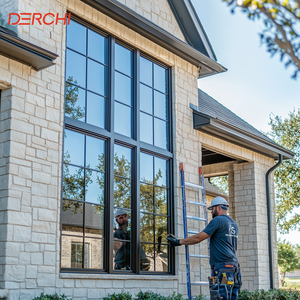
DERCHI Thermal Break Double Glass Casement & Entry System
- Profile: Multi-Chamber PVC-U
- U-Factor: 0.26 BTU/h·ft²·°F
- Hardware: Multi-Point Lock
Engineered for high thermal efficiency, acoustic attenuation, and architectural longevity. Shipped directly from verified OEM extrusion and welding facilities.
In modern architectural engineering, vinyl (unplasticized polyvinyl chloride or PVC-U) door assemblies are no longer selected merely for cost optimization. They represent high-performance thermal envelopes engineered to meet stringent carbon-neutral build mandates across Europe, North America, and global jurisdictions.
A true CE Certified Vinyl Door must strictly conform to EN 14351-1:2006+A2:2016 (Windows and doors product standard, performance characteristics). This mandates third-party verification of structural load capability, thermal transmittance ($U_w$), air permeability, and watertightness before receiving the Declaration of Performance (DoP).
Why European and international specifiers explicitly mandate fusion-welded profile joints in major construction schedules:
Corners become a single continuous piece of plasticized vinyl. Air infiltration drops to Class 4 (< 0.5 m³/h·m), and mechanical joint failure risk is zero across a 30-year lifecycle.
Relies on rubber gaskets and metal brackets. Over seasonal expansion cycles, sealant degrades, leading to corner racking, draft leaks, and structural sag.
Vertical control from raw PVC compounding to final insulated glass unit assembly guarantees zero compromised openings on commercial schedules.
Direct integration of triple-silver Low-E spectral coatings ($SHGC \le 0.22$) with warm-edge composite spacers and 90%+ Argon gas fill, cutting structural cooling load by up to 38% compared to standard dual-pane doors.
Every door shipment includes factory-traceable CE marking labels and verifiable Declarations of Performance (DoP) under EU Construction Products Regulation No 305/2011, ensuring smooth customs clearance globally.
Extruded profiles featuring 5 to 7 independent internal chambers that isolate cold air conductivity. Combined with heavy-duty EPDM weatherstripping, systems easily surpass Passivhaus requirements.
Heavy-duty hardware systems featuring mushroom-head steel cams, shoot-bolts, and lockable gearboxes tested to withstand DIN EN 1627 RC2 and RC3 forced-entry resistance standards.
Automated CNC cutting lines allow exact custom sizing in 1/8-inch (3mm) increments without lead-time penalties, providing flawless fit for both replacement retrofit and new architectural framing.
Available in high-durability PMMA (poly-methyl-methacrylate) laminated foils. Choose from architectural matte black, dark bronze, warm white, and authentic timber texture profiles with 10-year fade warranties.
How regulatory shifts, bio-based polymers, and digital twin window schedules are reshaping B2B fenestration purchasing through 2030.
European Union carbon border adjustment mechanisms (CBAM) are compelling global developers to demand transparent Environmental Product Declarations (EPDs). Leading CE-certified suppliers are transitioning to bio-attributed PVC resins derived from tall oil (a pine-wood byproduct) alongside closed-loop post-industrial vinyl recycling, cutting profile embodied carbon by up to 45%.
As energy performance standards tighten globally (such as Germany's GEG and California’s Title 24 Building Energy Efficiency Standards), double-pane fenestration is rapidly becoming obsolete for commercial projects. Future-proof procurement focuses on 70mm+ profile depths capable of housing 44mm triple-pane IGUs filled with Krypton or Argon gas.
Modern B2B door buyers no longer submit manually written window schedules. Enterprise procurement now demands direct export of Revit BIM models into automated factory CNC processing systems. This digital continuity ensures zero dimensional discrepancy between structural engineer specifications and factory fabrication outputs.
Empirical data benchmarking structural load, acoustic isolation, and certified thermal parameters across product lines.
| Series Designation | Thermal U-Factor ($W/m^2K$) | SHGC Range | Acoustic Rating (STC) | Wind Load (EN 12210) | CE Certification Code |
|---|---|---|---|---|---|
| 3G Max Commercial Patio Door | 0.78 - 1.10 | 0.20 - 0.28 | STC 42 (Laminated) | Class C5 (3000 Pa) | EN 14351-1:2016-CP01 |
| 5000 Series Sliding Vinyl Door | 1.12 - 1.35 | 0.22 - 0.35 | STC 36 (Dual Pane) | Class C4 (2400 Pa) | EN 14351-1:2016-CP05 |
| French Swing Vinyl Door Series | 0.85 - 1.20 | 0.21 - 0.30 | STC 40 (Dual/Lam) | Class B5 (2500 Pa) | EN 14351-1:2016-FD02 |
| 1733 Retrofit Narrow-Frame Door | 1.25 - 1.45 | 0.25 - 0.40 | STC 34 (Standard) | Class C3 (1800 Pa) | EN 14351-1:2016-RF09 |
| Tilt & Turn Utility Vinyl Entry | 0.72 - 0.95 | 0.18 - 0.25 | STC 44 (Triple Glaze) | Class E1050 (Watertight) | EN 14351-1:2016-TT03 |
Direct, unvarnished answers regarding factory verification, regulatory compliance, freight packaging, and product durability.
Under EU Regulation No 305/2011 (Construction Products Regulation), true CE compliance requires more than a self-issued certificate. The manufacturing factory must provide a legally binding Declaration of Performance (DoP) tied to standard EN 14351-1. This document must state verified Initial Type Testing (ITT) results from an accredited Notified Testing Laboratory for air permeability (EN 12207), watertightness (EN 12208), wind load (EN 12210), and thermal transmittance (EN ISO 10077-1). Additionally, the extrusion facility must maintain an audited Factory Production Control (FPC) system under ISO 9001.
Frame yellowing and chalking occur when low-grade PVC formulations break down under intense ultraviolet (UV-A and UV-B) radiation. Tier-1 CE certified factories utilize 100% virgin PVC-U compound resin blended with a minimum of 9 to 11 parts per hundred resin (phr) of Titanium Dioxide ($TiO_2$) rutile pigment, stabilized with eco-friendly Calcium-Zinc (Ca-Zn). Reground post-consumer scrap PVC is completely excluded from outer profile walls to maintain structural color fastness guaranteed for 20+ years under severe solar radiation.
Fusion welding melts the vinyl profile corners at 240°C-250°C, fusing the sash and frame chambers into a single, seamless monolithic plastic structure. Mechanical joinery relies on internal metal brackets, screws, and liquid sealants. Over multi-year thermal expansion cycles, mechanical fasteners loosen and sealants shrink, causing air leakage and frame racking. Fusion-welded corners maintain absolute structural integrity, zero air permeability, and higher corner break force resistance.
To prevent frame flexing and glass breakage during ocean transit, fully glazed vinyl doors are protected with protective corner caps, wrapped in heavy-duty 5-layer stretch film, and secured onto custom heat-treated fumigated wooden pallets or steel A-frame racks. Every unit is labeled with individual project door mark numbers corresponding to the master building schedule for rapid site distribution upon container de-stuffing.
Yes. Utilizing advanced European co-extrusion technology or high-durability acrylic exterior foils (such as Renolit or Hornschuch film), vinyl doors can be finished in solid matte black, dark architectural bronze, anthracite grey, or natural timber textures. These laminated foils incorporate Cool Colors Technology, reflecting up to 80% of near-infrared solar energy to keep profile core temperatures low and prevent heat distortion.
Standard lead time for custom-sized, fully factory-glazed container orders (e.g., 20ft or 40ft HQ) ranges between 20 to 30 business days following CAD shop drawing approval and deposit receipt. For standard stock profile colors (White/Anthracite), accelerated 15-day manufacturing cycles are available for contract partners.
Submit your door schedules, Revit BIM drawings, or project tender specifications. Our technical engineering team will deliver line-by-line CE compliant quotations, U-factor verification calculations, and physical profile sample kits.